
Search Engine Optimize or SEO is an extensive process of optimizing your website pages for relevant keywords. It helps websites rank higher in search engines and gain visibility in the online marketplace. Websites that rank higher in SERPs pull more visitor traffic since visitors always tend to click on top-ranking websites.
With the right optimization strategies in place, you can bring your website in front of your potential buyers who are discovering the products and services you are offering. SEO can play a pivotal role if you want to generate organic ranking and traffic on your website.
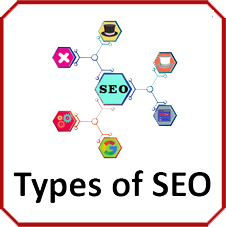
In this article, I will cover different types of SEO. As the blog goes on, you will be able to know about the basics of those SEO types and how to conduct them properly.
1. On-Page SEO
This is a kind of SEO where consultants optimize the on-site elements and improve the web pages of a particular website to improve visibility and increase search ranking. On-page optimization takes care of optimizing both the content and HTML source code of individual web pages of a website. The primary goal of on-page optimization is to enable visitors to have smooth navigation while they are visiting your website.
Key components of an on-page Optimization strategy:
Title tag
Page titles are also called meta titles. A page title gives search engine crawlers an idea of what the page is all about. In Search engine result pages, the title appears below the URL and above the description. To ensure that your title gets more clicks, keep it crisp, within the character limits, and optimized for your keywords. The title must address the search intent of the users.
Page Headings
Sometimes, Google doesn’t pick the meta title you specified. Instead, the search giant pulls other headings from the pages as the page title. This is why each heading used on that page should be optimized well. Optimized page headings including H1, H2, and H3 may have a great impact on your search efforts. All the headings being used on the page should be attractive enough to draw the reader’s attention to them.
Page Content
Content is the core component of a website that can make or break it. In the AI age, content quality matters the most over frequency. While producing the content, ensure that the content has an organic mix of your primary, secondary, and similar keywords and elaborates the topic well. A well-written content should be keyword-rich and must answer the user queries in detail.
Internal Links
Interlinking of website pages significantly improves your website optimization efforts. Internal links help link equity flow throughout the site. Technically, internal links are any links that link one page on your website to another page.
These links help both users and crawlers to find and understand the content on your website. Moreover, internal links make it easier for website visitors to navigate the website pages and find a particular page they are looking for.
2. Off-Page SEO:
Off-page SEO comprises all other activities other than on-page search engine optimization. Off-page activities are done outside the website and might include (not limited to) activities like link building, social media, and local SEO.
The goal behind adopting this strategy is to improve your website visibility, generate more organic traffic, and build a brand. Like on-page, Off-page optimization also helps your business website to significantly improve its ranking on the search engine results page.
Key components of an off-page Optimization strategy
Backlinks
This is the most important off-page strategy. Quality backlinks boost domain and page authority and are considered the topmost ranking factor by Google. The search giant prefers websites with high-authority links when finding rank-worthy websites.
While creating a link-building plan, make sure that the links acquired should be authoritative and relevant. Authority links can automatically general a lot of referral traffic. Websites with more authority backlinks are considered trustworthy and reliable sources of information.
Social Media Marketing
Social media platforms can help you to create better audience outreach. Optimizing your social media network is indeed a great off-page optimization strategy. Social media marketing not only helps to get more clicks on your social media content pieces and obtain valuable backlinks.
Though social media signals don’t directly impact the search rankings, it helps brands to generate a more loyal follower base and build a solid brand base. Writing and publishing insightful content on social media platforms receive more shares, hence increasing the likelihood of getting more backlinks.
3. Technical SEO
Technical SEO includes every optimization activity on your website that you perform to help search engines find, crawl, understand, and index your pages. By doing technical SEO in the right way, you can fix website errors, improve website visibility and increase rankings.
Technical SEO is always under your control but a complex process to handle. Technical SEO isn’t directly linked to the website content or any kind of promotional activities. It’s conducted in all its virtue to improvise the infrastructure of a website.
Some of the important activities that consultants do take up during technical SEO are the following:
- Robot text optimization
- URL optimization
- Website Navigation
- Structured Data markup
- Sitemap optimization
- Mobile Optimization
- Website Spee
4. Local SEO
Local SEO involves search engine optimization activities to increase the online visibility of your store so your business can be found by the buyers living in your neighborhood. If you operate your business throughout a certain geographic area, you can utilize local SEO to generate more footfall and business revenue. Local SEO is considered beneficial for businesses that serve a certain geographic area.
hen optimizing for local search, you can rely on localized content and local link popularity. In case you’re running a multi-location business, it’s advised to build local landing pages for every location you are serving. Moreover, include mandatory business information such as name, address, and phone number to help your potential customers find you quickly. Follow SEO best practices to outrank your local competitors.
5. E-commerce SEO
E-commerce SEO is an extensive process of optimizing your online store to ensure that your product pages appear on top search results when potential buyers trigger a search for a related product. If you just have begun with your online store, e-commerce SEO can help your potential buyers discover your brand and make purchases.
You appear in more search results, which helps more people discover your brand. E-commerce SEO can be a great tool to increase product visibility and brand recognition. When your potential buyers find your products in search results, they explore more about them and purchase.
Conclusion
Whichever industry you serve, an ideal SEO strategy is something that helps to drive expected results and fulfill goals. The article covers in brief the different types of SEOs that help businesses generate traffic on their website, increase visibility for their products and services and generate good revenue.
 SEO or search engine optimization is a process to optimize website’s web pages for visibility and higher ranking in search engines. SEO is both an art and science and quite complex in nature. Irrespective of its types, the aim is to bring a website on the forefront of users and rank it better for different search terms.During the